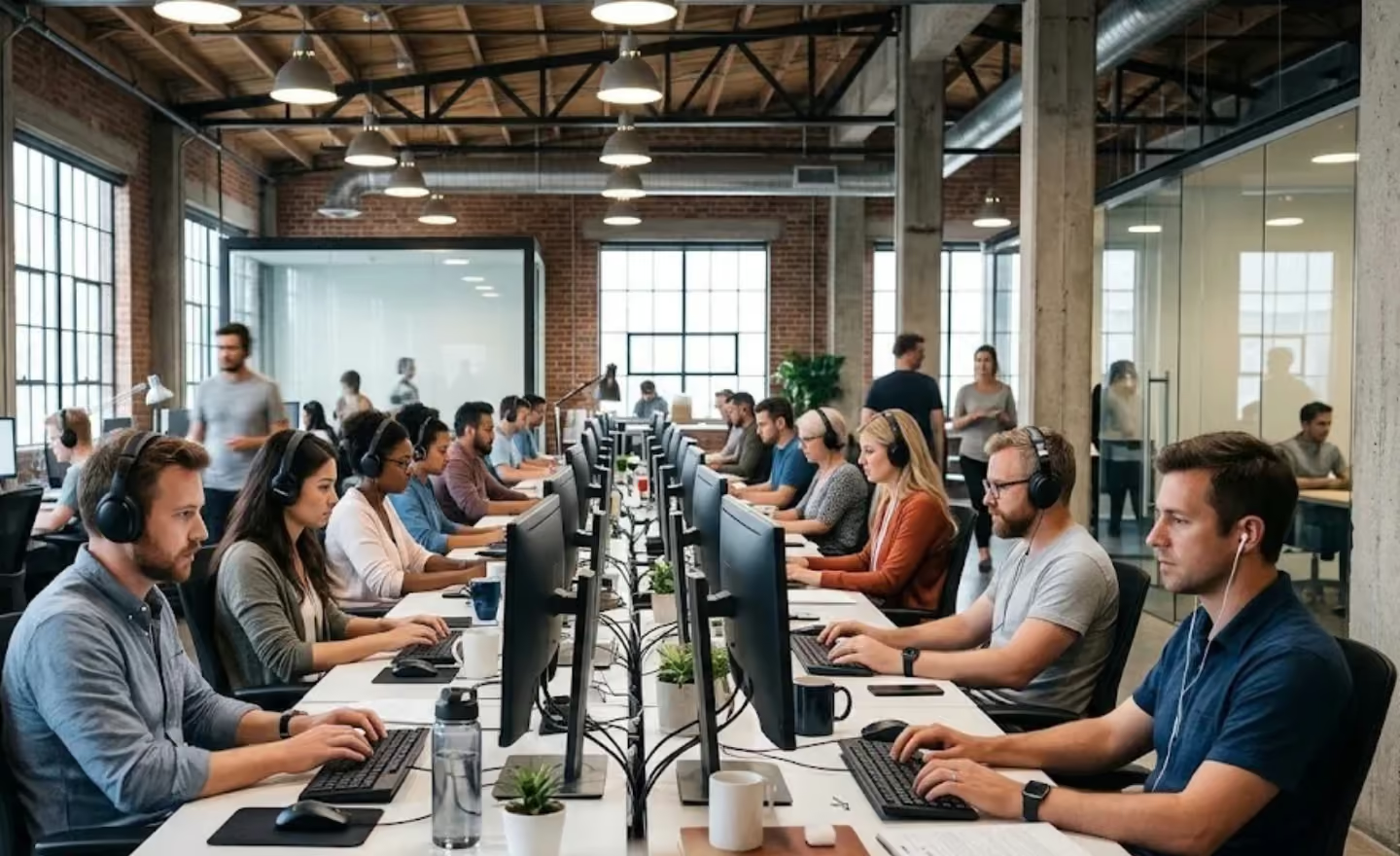
Home Depot, Instagram, Fidelity and TikTok have all recently told employees to come back five days a week. The mandates are working, in the narrow sense that more people are in the building. What is less clear is whether being in the building is doing anything.
Two economists, Natalia Emanuel of the New York Fed and Emma Harrington of the University of Virginia, surveyed 1,835 college-educated American workers in September and found something interesting. Writing in The Atlantic, they report that on respondents' most recent day at the office, more than 70 percent had at least one member of their team who was not in the building with them. Roughly half had no fully in-person meetings. More than a third had exclusively online meetings, because their teams moved meetings entirely online whenever anyone was remote.
And among workers who had meetings at all, 52 percent had at least one held online even though everyone on the call was in the same building.
Their line for this is better than anything we could write: for these workers, the commute buys little more than a different background on their video calls.
Why it keeps happening
The obvious explanation is that people are ignoring the mandate. That is part of it, but it is the smaller part, and it is not the interesting one.
The bigger reason is that teams are no longer in one place. During lockdown, companies hired wherever the talent was and let existing employees move away, and most of them never unwound it. At one Fortune 500 firm Emanuel and Harrington studied, about 60 percent of corporate employees had at least one distant teammate after the pandemic, up from roughly 20 percent before. Among small businesses, the distance between employees and the central office nearly tripled between 2019 and 2023. Fortune 500 job postings now list multiple possible office locations five times as often as they did a decade ago.
The consequence is simple arithmetic. If one person on a team of eight is in another city, the team meeting is an online meeting. It does not matter how many of the other seven commuted in. A mandate cannot fix a seating chart that spans three time zones.
The second reason is habit. People got used to working through a task list alone and came to see hallway conversation as an interruption rather than part of the job. That shows up in attendance, which decays quietly: Emanuel and Harrington find the typical worker comes in one day fewer than their company requires. Ask for four and you get three. And because one absence degrades the day for everyone else, the decay spreads. Managers matter most here. When a leader stays home, the team reads it accurately and follows.
Then there is the smallest habit and maybe the most telling one. Even when everyone is in the building, people send a Zoom link rather than walking to a conference room. It feels efficient. It saves four minutes.
The policy answered the wrong question
Return to office policies answer where people should work. Almost none of them answer what people should do once they get there.
That gap is where the whole problem lives. A mandate can put forty people in a building. It cannot make them talk to each other, and the research suggests it mostly does not. Emanuel and Harrington found that having even one distant teammate weakens the connections among the people sitting side by side, because the meeting moves online for everybody once it has to accommodate anyone.
So attendance is not the thing that was ever actually valuable. Attendance is the precondition. The valuable thing is the set of interactions attendance makes possible, and those do not happen automatically.
This is worth being honest about, because the evidence on proximity is less flattering than the people writing mandates seem to think. When researchers studied two large companies that moved to open plan offices, measuring interaction with sensors rather than surveys, face-to-face interaction fell by roughly 70 percent and email went up. Putting people near each other is not the same as getting them to talk. Sometimes it does the opposite.
Which means the office only works if something in it is designed to bring people together. Otherwise you have built an expensive room full of people wearing headphones.
What the researchers say is missing
Emanuel and Harrington are specific about what gets lost when a meeting moves online even though everyone is in the building. It is not the meeting. The meeting happens either way. What disappears is "the chat before the meeting starts, the debrief on the way back to your desk."
That is a precise description of where most workplace relationships actually form. Not in the meeting, around it.
Their proposed fixes are serious and mostly expensive: pay remote workers to relocate, concentrate hiring near each team's hub, run regular off-sites, and rewrite performance reviews so that mentoring and creative work count for something. Those are real answers and most companies will do none of them this year.
Here is the argument they do not make, and we will: a shared meal is the same mechanism as an off-site, running weekly instead of annually, at a tiny fraction of the cost.
An off-site works because it takes people out of their individual task lists and puts them in a shared block of time with no agenda attached. A lunch does exactly that, for an hour, every week, without a venue booking or a budget request. It is the cheapest recurring version of the thing the research says is missing.
What to actually do
Four things, in rough order of how much they matter.
Put the meal on the days teams are actually together. Not Mondays because Mondays are quiet. Find the day your team genuinely overlaps and anchor it there. If your team is spread across offices, this is the moment to notice that, because the sprawl problem applies to you and no lunch will fix it. Worth adding that this does not have to be lunch. A standing breakfast catches people before the day fragments into calls, which is arguably a better slot for exactly the problem described here.
Set a common window and hold it. A lunch where everyone eats at their desk between calls is catering, not connection. Thirty minutes that nobody books over is the entire intervention.
Have leadership eat the same food in the same room. Executive dining undoes this completely. If the people running the company are not there, everyone correctly reads it as an amenity rather than a priority. This is the same signal as the manager who stays home on an anchor day, and people read it just as fast.
Measure something other than badge swipes. Attendance tells you the mandate is being followed. Participation, cross-team interaction and whether people say the day was worth the commute tell you whether any of it worked.
The point is not the lunch
Emanuel and Harrington end by saying that not every workday has to be in the office, but that ensuring in-office days are in-person days could make work feel more human. That is the right framing and it is a higher bar than attendance.
The goal is not to bait people into commuting with free food. If the only reason to come in is lunch, the problem is bigger than lunch. The goal is that when someone does make the trip, something is waiting that could not have happened at home.
A shared meal is one of the cheapest and most repeatable ways to make sure something is.
Sharebite helps companies run recurring meals around the days their teams are actually together, with flexible ordering that handles changing headcount and dietary needs. See how it works, or book a demo.