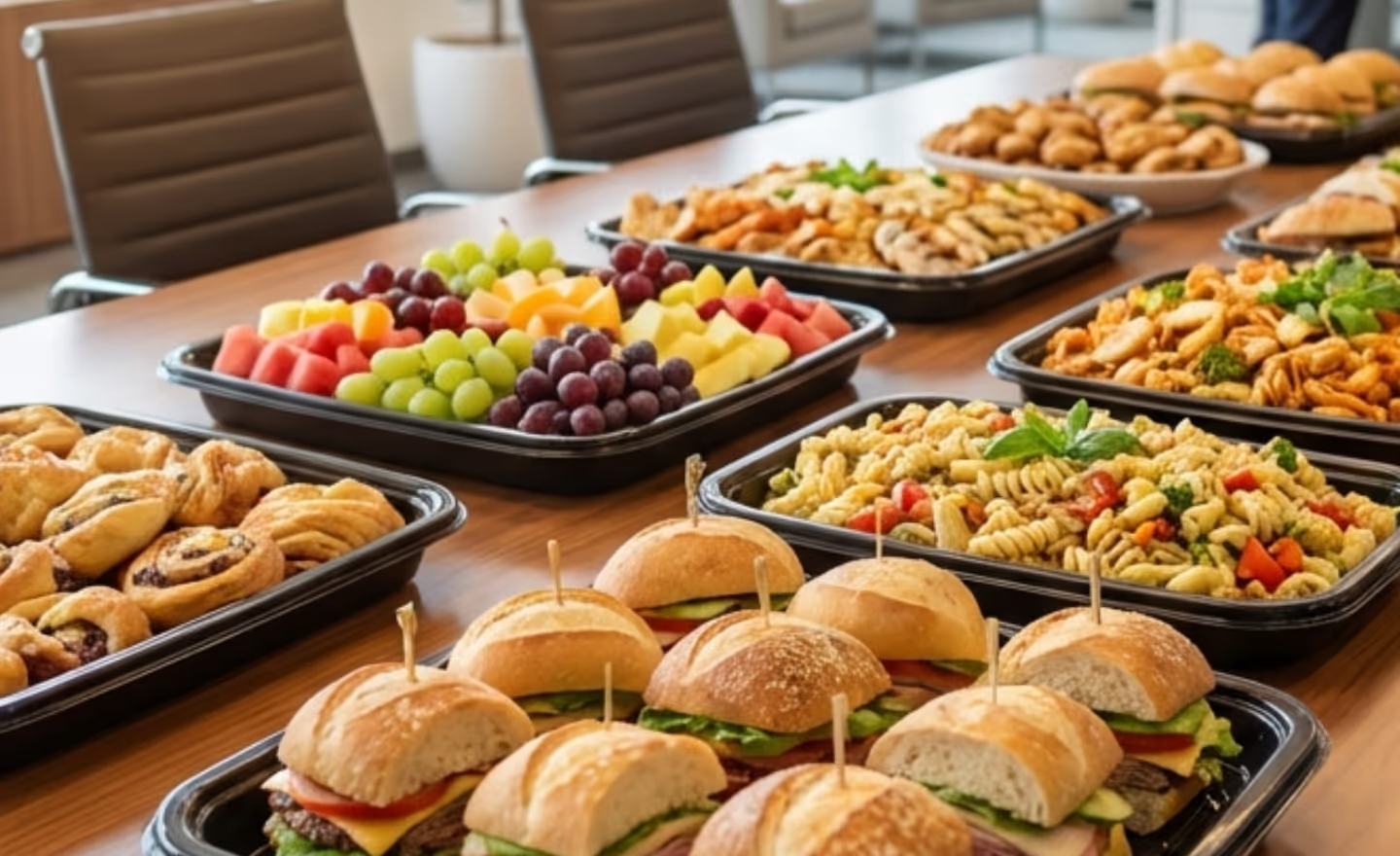
Imagine this, you ordered lunch for 50 people. Only 32 showed up.
Now there's $300 worth of sandwiches wilting in the break room, and you're the one who has to decide whether to guilt-eat three turkey clubs or watch perfectly good food go in the trash (or get left in the fridge and then thrown out). Again.
This isn't bad planning. It's not even bad luck. It's the structural reality of trying to feed hybrid teams with catering trays designed for a world where everyone showed up to the office Monday through Friday.
That world is gone. But some companies are still feeding teams like it exists.
Here's the thing. Catering trays usually require you to commit to a headcount 24 to 48 hours in advance. In a hybrid environment where Jessie decides to work from home at 9am and Mike's kid gets sent home sick at 11, that commitment is basically a guess. And guessing costs money.
The alternative is Sharebite Stations, our group ordering platform designed specifically for this problem. Instead of estimating how many people might show up, you let employees opt in. They choose their individual meals from a curated selection of top local restaurants. You pay for actual attendance.
Zero waste. Predictable budgets. Happier teams.
Let me show you why the old catering model is bleeding your budget, and why Sharebite Stations might be the most underrated operational upgrade you can make.
The Hidden Math of "Trays for 50"
Most companies know they waste food. Very few have actually calculated what it costs them.
Let's do the math on a typical scenario. You've got a 50-person team. Hybrid schedule. You do a weekly team lunch to keep everyone connected. Noble goal.
You order catering for 55 people because you've learned to add a buffer. Smart. The caterer recommends it. At $12 per person, that's $660 for the meal.
Actual attendance on any given week? Could be 45. Could be 35. Let's say it averages 38.
You just paid $660 to feed 38 people. That's $17.37 per person. You're paying a 45% premium for empty plates.
Run that for a year. Fifty team lunches at $204 of waste each time. That's $10,200 going directly into the trash can. And that's just one weekly lunch for one team.
Now multiply that across multiple departments. Multiple offices. Multiple recurring meals.
The numbers get uncomfortable fast.
The Guessing Game Nobody Wins
Here's how it usually goes. Monday morning you send the Slack message: "Team lunch Thursday! Who's in?"
You get 30 responses. Maybe. If you're lucky. You send a reminder Tuesday. A few more trickle in. Wednesday at noon you have to place the order, and you've got 35 confirmed yeses, 8 maybes, and 7 people who haven't responded at all.
So you guess. Order for 50. Add a buffer. Hope for the best.
Thursday arrives. Three people called in sick. Five decided to work from home. Two are in back-to-back meetings and can't break away. One person is on PTO that nobody told you about.
You've got 40 people and food for 55.
Or worse. You guessed conservative. Ordered for 45. Fifty-two people showed up. Now you're the person who has to tell half the engineering team there's no lunch left. That's not a budget problem, that's a morale crisis.
The penalty for guessing wrong goes both ways. Over-order and you waste money. Under-order and you create resentment. There's no winning when you're operating on incomplete information.
It's Not Just Money, It's Culture
Let's talk about the optics for a second.
Your company probably has some kind of sustainability initiative. Maybe you're tracking carbon emissions. Maybe you've got reusable coffee mugs in the break room and recycling bins everywhere.
And every Thursday, people watch you throw away 15 perfectly good sandwiches.
This matters more than you think. Gen Z and millennial employees care deeply about waste. They notice. They talk about it. The irony isn't lost on anyone. You're trying to build culture with team meals, but the visible waste undermines the whole point.
It's the small stuff that shapes how people perceive leadership. Do you practice what you preach? Or do you talk about efficiency while lighting money on fire every week?
How Sharebite Stations Actually Works
Sharebite Stations flips the model entirely. Instead of you guessing headcount and ordering in bulk, employees opt in and select individual meals from a curated rotation of top local restaurants.
Here's the basic flow. Monday you schedule a team lunch for Thursday from noon to 1pm through the Stations platform. The system automatically sends notifications to your team. Employees have until Wednesday at 5pm to browse the restaurant options (think Cava, Dig, Sweetgreen, and other quality local spots) and customize their exact meal with modifications just like any consumer app.
Want no cheese? Remove it. Extra protein? Add it. Gluten-free? Filter for it. It's not "here's what you get, enjoy it." It's true customization.
Wednesday at 5:01pm, the order locks. No more additions. No more changes. But here's what's happening behind the scenes that you never see: our team has already coordinated with restaurants a week prior to confirm they can handle your volume. This isn't them finding out last minute and trying to juggle everything.
Thursday, meals arrive in one coordinated delivery with 98% on-time accuracy. Each meal is individually packaged and labeled with names. No gig workers figuring out your building for the first time. Our delivery team knows your freight elevator, your contact, all the details.
From an admin perspective, you set it up once and it runs. Schedule recurring team lunches. The system handles reminders. Employees manage their own selections. You get one consolidated invoice at the end.
You're not guessing. You're counting.
What This Looks Like in Practice
Let's run the same 50-person marketing team scenario through both models.
Traditional Catering:
- You estimate 50, order for 55 with buffer
- Call the caterer, pick 2 or 3 sandwich options, hope people like them
- Place order 48 hours ahead
- Cost: $660 for 55 people
- Actual attendance: 38 people
- Waste: 17 uneaten meals worth $204
- Admin time: 30 to 45 minutes coordinating
- Someone with dietary restrictions gets stuck with the vegetarian option they don't actually want
- Social impact: None
Sharebite Stations:
- Announce lunch, set opt-in deadline
- 38 people opt in and select individual meals from multiple restaurant options
- Order locks automatically at deadline
- Cost: $456 for 38 people
- Actual attendance: 38 people (because they opted in)
- Waste: Zero
- Admin time: 5 minutes to set up, automated after that
- Everyone gets exactly what they want, dietary needs built into selection
- Social impact: 38 meals automatically donated to local food banks
The Math Adds Up Fast
The difference isn't subtle. You saved $204 on one lunch. You eliminated waste entirely. You gave employees more choice and autonomy. Your team helped feed 38 people in need. And you got 30 minutes of your life back.
Run that 50 times a year. You just saved $10,200, donated 1,900 meals to your community, and reclaimed about 25 hours of administrative work. That's real money, real impact, and real time you can deploy somewhere more valuable.
When Catering Trays Still Make Sense (And When to Use Passport Instead)
Look, I'm not going to tell you Sharebite Stations is the answer for every situation. It's not. There are absolutely times when traditional catering is the right call, and times when our other product, Sharebite Passport, is the better fit.
Catering trays work great when:
- You've got a fixed, captive audience. All-day offsite where everyone is definitely present the whole time.
- Very small groups. Eight to ten people in a conference room where family-style actually makes sense.
- Immediate need. You need lunch in two hours and don't have time for an opt-in process.
- Specific presentation requirements. Client-facing events where aesthetic and presentation matter.
Sharebite Stations wins when:
- Hybrid teams. Attendance fluctuates week to week.
- Recurring meals. Weekly team lunches, monthly all-hands, regular rituals.
- Diverse dietary needs. Large teams with vegetarians, vegans, gluten-free, halal, kosher, and everything in between.
- Budget accountability. You need precise spend tracking and waste reduction.
- Employee engagement. You want to boost the perceived value of the meal benefit.
Sharebite Passport works great when:
- Maximum flexibility is needed. Remote employees, field teams, or anyone working outside the office.
- Varying schedules. Teams with different lunch times, overnight shifts, or 24/7 operations.
- Individual preferences reign supreme. Passport is a virtual Visa® card that lets employees order from any restaurant, in person with tap-to-pay, online directly, or via delivery apps like DoorDash, Uber Eats, or Grubhub.
- Budget control is critical. Set daily limits, restrict to food merchants only, geofence to office areas during work hours.
- You want to complement Stations. Some employees join the group order, others use Passport for individual flexibility. Same allowance, maximum satisfaction.
The smart move isn't to pick one and use it forever. It's to match the tool to the context. Use Stations for recurring hybrid team meals. Use Passport for distributed teams or to give employees flexibility alongside Stations. Use catering for your annual holiday party. All three have a place.
The Objections You're Probably Thinking
"But catering feels more team-building"
Does it though? Team-building happens when people sit together and talk. The delivery mechanism for the food doesn't create connection. The conversation does.
You can absolutely still eat together with Sharebite Stations. You're just eating individual meals instead of shared platters. And frankly, most companies find that individualized choice actually increases meal attendance because people aren't showing up to find out there's only turkey sandwiches left.
"Sharebite Stations seems complicated"
It's less complicated than coordinating five different dietary accommodations via email with a caterer at 4pm the day before.
Sharebite Stations is designed for admins, not IT teams. Set-up takes about an hour. Ongoing time per order is five minutes. The system does the work.
"What if people don't opt in?"
Set a clear deadline. Make opting in easy. When the deadline passes, the order locks.
People learn fast. Miss lunch once because you didn't opt in, you remember the next time. The platform sends automatic reminders. Typical opt-in rates run 60% to 80%, which is way better than trying to guess attendance with a Slack poll.
"What about employees with strict dietary restrictions?"
This is where combining Stations and Passport becomes powerful. Your main team gets the group ordering experience with Stations: curated restaurants, coordinated delivery, everything arrives together.
But that employee with severe allergies? The vegan who wants more options? The person who needs halal or kosher? They use their daily allowance with Passport to order from any restaurant that works for them.
Maximum flexibility. No one is left out. No one goes hungry because the group order doesn't work for them. Having both options means 100% satisfaction with zero compromises.
"We have relationships with our caterers"
Keep them for the things they're good at. Big events. Special occasions. Client meetings where presentation matters.
This isn't about abandoning caterers. It's about using the right tool for each job. Catering for the annual holiday party. Sharebite Stations for weekly team lunch. Passport for distributed teams and flexibility. All three can coexist.
But Here's What Makes This Different
Here's something most meal platforms won't tell you: your lunch program could be fighting food insecurity at the same time.
Sharebite was founded on a mission to alleviate hunger in America. Our CEO, Dilip Rao, an immigrant from India, witnessed food insecurity firsthand and committed himself to addressing this crisis. For every meal ordered on the Sharebite platform, we donate a meal to someone in need through partnerships with Feeding America and City Harvest. To date, we've donated over 15 million meals.
This isn't a CSR add-on you have to manage. It happens automatically. Your employees see their personal impact right on their dashboard: how many meals they've donated just by eating lunch. It deepens the meaning of the benefit and connects your team to their community at no extra cost to you.
Think about it: 50 weekly team lunches with 38 people attending means 1,900 meals for your team and 1,900 meals donated to local food banks. That's tangible impact with zero additional effort.
When employees see that their lunch routine is feeding families in their own city, it transforms the benefit from transactional to meaningful. That's culture building that actually sticks.
The Bottom Line
In a world where everyone showed up to the office five days a week, catering trays made perfect sense. Order for your headcount, lay out the food, everyone eats. Simple.
That world doesn't exist anymore.
In a hybrid environment, feeding teams with catering trays means you're either wasting money on food nobody eats, or scrambling when you under-order and people go hungry. Neither is sustainable. Neither is fair to you or your budget.
Sharebite Stations solves the fundamental problem. It eliminates the guessing game. Employees opt in. You pay for actual attendance. Waste drops to zero. Budget variance disappears. Your team gets more choice. You get your time back. And every meal ordered feeds someone in need in your local community.
The question isn't whether this model is better. The math makes that pretty clear. The question is how much you're willing to waste before you make the change.
Curious what this looks like for your team size and location? Schedule a quick demo and we'll walk through the platform, the pricing, and your potential savings.