Ask ten Americans to name a sandwich and you'll likely get ten unique answers shaped almost entirely by where they grew up. A person from Buffalo will say beef on weck and assume you know what a weck is. Someone from St. Louis will describe an egg foo young patty on white bread with a straight face. In Chicago they might describe a sandwich that gets dunked in gravy before it reaches you.
American sandwiches are regional in a way that most American food isn't anymore. Chain restaurants flattened a lot of our culinary geography, but the sandwich mostly survived, because it was always the food of people who needed lunch fast and affordable and built it out of whatever the local butcher, baker and the local community had on hand. A sandwich is a fingerprint of a neighborhood at a moment in time.
We went through 25 of them, coast to coast. Along the way we found that a surprising number of the origin stories everyone repeats fall apart under a little scrutiny, so we've flagged the ones that don't quite hold up.
The Northeast
1. The Philly Cheesesteak - Philadelphia, Pennsylvania
What's on it: Thin-sliced ribeye grilled with onions, piled into a long soft roll (Amoroso's is the benchmark) and covered in cheese.
What makes it different: The cheese question is the whole argument. Cheez Whiz is the iconic choice and dominates at Pat's and Geno's, where Whiz outsells American something like eight to one. But those two stands run heavily on tourists, and when the Philadelphia Inquirer polled readers, most locals said they order provolone or American. But both things can be true at once.
Where it came from: Pat and Harry Olivieri, by family account, around 1930 at what became Pat's King of Steaks. Note that the brothers were selling a steak sandwich; the cheese came later, added by a manager named Joe Lorenza at the Ridge Avenue location. Sources disagree on whether it was provolone in the 1940s or American in 1951. What we can say for certain is that it wasn't Whiz, because Kraft didn't put Cheez Whiz on the market until 1952.
One more thing Philadelphians would want us to mention: plenty of them argue the city's best sandwich is the roast pork Italian with sharp provolone and greens, and the official sandwich of Philadelphia isn't the cheesesteak at all. It's the hoagie, designated in 1992. Which brings us to:
2. The Italian Hoagie - Philadelphia and South Jersey
What's on it: Layered Italian cold cuts (capicola, salami, mortadella, prosciutto), sharp provolone, shredded lettuce, tomato, raw onion, hot peppers, oregano, oil and vinegar. Untoasted, always.
What makes it different: Structure. A hoagie is built in layered structure so every bite gets everything, and the oil is supposed to soak slightly into the crumb before you eat it. This is also the rare sandwich that improves during a twenty-minute delivery.
Where it came from: The word is the interesting part, and the story you've heard is probably wrong. Everyone repeats that Italian workers at the Hog Island shipyard during World War I ate "hoggies." The Encyclopedia of Greater Philadelphia calls that unlikely for a concrete reason: the word doesn't appear in print until 1945, in the Philadelphia City Directory, with the Oxford English Dictionary not recording common usage until 1967. A roughly 25-year silence is hard to explain. Scholars tend to favor Al DePalma, who opened a shop in 1936 and joked that a friend would have to be "a hog" to finish one of his sandwiches. There are at least seven competing theories but we don't have time to dive into all of those.
3. Pastrami on Rye - New York City
What's on it: Hand-sliced pastrami, piled high, on seeded rye with deli mustard. Nothing else besides a pickle on the side.
What makes it different: Pastrami is brined, coated in a heavy pepper-and-coriander rub, smoked and then steamed, which is why it's meltingly soft in a way corned beef isn't.
Where it came from: Romanian and Bessarabian Jewish preservation technique, carried to the Lower East Side. The name traces through Yiddish pastrame back to Turkish pastırma. In the old country it was made from goose breast; in America, Romanian Jewish butchers switched to beef navel because it was easier to source. A butcher named Sussman Volk is usually credited with the first pastrami sandwich on Delancey Street around 1888, though that rests on family account rather than records.
Worth knowing if you're at Katz's: the famous "since 1888" is liekly wrong. Food historian Robert F. Moss went through the records and found that the brothers who founded it didn't immigrate until 1902, which would have made them 11 and 6 years old in 1888. The city directory first lists the delicatessen in 1911.
Feeding a team? See Deli catering in New York City
4. Beef on Weck - Buffalo, New York
What's on it: Rare roast beef, sliced thin, on a kummelweck roll, with horseradish you spread yourself and a dip of jus on the top half.
What makes it different: The roll. A kummelweck is crusted with coarse salt and caraway seeds (German Kümmel for caraway, Weck for roll), hard outside and doughy inside. Salt and caraway against rare beef and horseradish is the entire idea, and no other American roast beef sandwich does it.
Where it came from: Nobody actually knows. Local legend credits a German baker named William Wahr in the late 1800s. Notably, the official historical marker that went up in 2021 outside Schwabl's in West Seneca hedges: "Believed first served in late 1800s." The foundation that erected it says plainly that it's uncertain who served the first one. The 1901 Pan-American Exposition in Buffalo is the best-documented reason it spread. There's also a charming, entirely unsourced story about a publican who figured a salty roll would sell more beverages.
Classic American catering in New York City
5. The New Jersey Sloppy Joe - Northern New Jersey
What's on it: Three slices of thin rye, two kinds of deli meat, Swiss, coleslaw and Russian dressing, cut into small squares.
What makes it different: It has nothing whatsoever to do with the ground-beef-and-tomato-sauce sloppy joe. No ground beef, no sauce, no relation. New Jersey supermarkets sometimes label it "turkey sloppy joe" purely to prevent confusion. It's a cold triple-decker, it's cut for a crowd, and if you order one expecting the other you will be surprised.
Where it came from: Town Hall Deli in South Orange, by tradition. The story goes that Maplewood's mayor, Thomas Sweeney, visited Sloppy Joe's bar in Havana in the 1930s and asked the deli to recreate what he'd eaten there. The Havana bar was real. Whether Sweeney's visit happened is another matter, and the deli's own vice president has said flatly that no one has a clear story about it.
6. Pork Roll, Egg and Cheese - New Jersey
What's on it: Griddled pork roll, fried egg, American cheese, salt, pepper, ketchup, on a kaiser roll.
What makes it different: Cooks cut four small slits in each round of pork roll before it hits the griddle, otherwise it blows up like a balloon. Those slits are the tell of someone who's made countless of them.
Where it came from: John Taylor of Trenton, whose Taylor Provisions Company was established in 1888. The naming question has a real answer, and it's the opposite of what most people assume. "Taylor Ham" is the older commercial name; a 1910 court case records that the label had to change because the product "did not consist of ham," so the company adopted "Pork Roll" instead. Federal labeling law, specifically the 1906 Pure Food and Drug Act, is why New Jersey has two names for one thing. North Jersey leans Taylor Ham and central and south Jersey lean pork roll, though the surveys behind that are admittedly unscientific.
Breakfast catering in New York City
7. The Primanti Bros. Original - Pittsburgh, Pennsylvania
What's on it: Grilled meat, melted cheese, tomato slices, vinegar coleslaw and a handful of fresh-cut fries, between two slices of soft Italian bread.
What makes it different: The fries and slaw go inside, and the slaw is vinegar-based rather than creamy, which matters more than it sounds. The acid is the only thing standing between you and a very heavy sandwich.
Where it came from: Joe Primanti started with a cart during the Depression, and in 1933 he opened in the Strip District with his brothers Dick and Stanley and nephew John DePriter. Everyone tells you the fries went inside so truckers could eat one-handed while driving. DePriter's own account is better and less tidy: a hauler came in with a load of potatoes and brought a few over to see whether they'd frozen. DePriter fried them on the grill, they looked good, and customers started asking for them on the sandwich. The trucker explanation appears to have been reverse-engineered later.
8. The Lobster Roll - Maine and Connecticut
What's on it: Two schools. Connecticut serves warm lobster meat in drawn butter on a grilled split-top bun. Maine serves it chilled, lightly dressed in mayonnaise, on the same bun.
What makes it different: It's split-top bun, similar to a hotdog bun but wider. The flat sides mean you can butter and griddle it.
Where it came from: Genuinely murky. Perry's in Milford, Connecticut usually gets credit for around 1929, but no menu, ad or record has ever surfaced, and the earliest print reference anyone has found is from 1937. Meanwhile a Maine family claims their great-grandmother was making them with mayonnaise on white bread between 1915 and 1917, which is both earlier and the other style. As the Maine Lobster Marketing Collaborative put it, it would be hard to disprove anyone who claims to be first. Anyone who tells you confidently which style came first is guessing.
The Mid-Atlantic
9. Baltimore Pit Beef - Baltimore, Maryland
What's on it: Charcoal-grilled top round, heavily charred outside and rare within, shaved thin onto a kaiser roll with raw onion and tiger sauce.
What makes it different: It is not barbecue. Pit beef is grilled hot and fast over charcoal, not smoked low and slow, and the char is the point. Tiger sauce is roughly two parts mayonnaise to one part horseradish, and it's not optional.
Where it came from: Unknown, and the Baltimore Sun has tried. Their investigation concluded the origins are murky, with the earliest print trace a 1968 ad for a tavern on Pulaski Highway. The Sun also looked for an explanation of why Baltimore grills its beef when the rest of the country smokes it and couldn't find a persuasive one, so be suspicious of any article that offers you a reason. What is clear is that Boog Powell's stand at Camden Yards, opened in 1992, is what made the rest of the country notice.
10. The Maryland Crab Cake Sandwich - Chesapeake Bay
What's on it: Ideally a blue crab cake with little to no filler seasoned with Old Bay, broiled or fried, on a soft roll.
What makes it different: Restraint. The prestige version uses as little binder as possible so the lumps of crab stay intact. At Faidley's in Baltimore's Lexington Market the cake is famously served on saltines instead of a bun, which tells you where the priorities lie.
Where it came from: Later and further north than the lore suggests. The story about Native Americans making crab cakes with cornmeal and bear fat comes from a James Michener novel, and folklorists have found nothing to support it. The earliest known printed recipe is from 1891, in a book by a New York caterer named Thomas J. Murrey. Old Bay didn't exist until 1939, roughly fifty years after the dish. Even the "all lump, no filler" standard is recent, traceable to Nancy Faidley Devine's recipe in 1987.
The South
11. The Po' Boy - New Orleans, Louisiana
What's on it: Fried shrimp, fried oysters, roast beef with debris gravy, or hot sausage, on New Orleans French bread. "Dressed" means lettuce, tomato, pickle and mayonnaise.
What makes it different: The bread, which exists nowhere else. New Orleans French bread has a shell so thin it shatters and a crumb so airy it's practically hollow, which is the only reason a pound of fried shrimp is structurally possible.
Where it came from: The famous version has the Martin brothers, former streetcar conductors, feeding strikers free during the July 1929 walkout and naming the sandwich for "poor boys." Their letter is real and it's a wonderful document. It also never mentions sandwiches. And Louis Armstrong's autobiography describes eating "poor boy" sandwiches as a coal delivery boy before 1918, with Sidney Bechet recalling the same thing in the 1910s. The likeliest reading is that the sandwich came out of Black New Orleans neighborhoods that the contemporary white press simply didn't cover, and the Martins popularized and probably first printed the name. One footnote for accuracy: the long loaf built specifically for the sandwich is credited to baker John Gendusa, not to Leidenheimer, which is the dominant modern supplier.
12. The Muffuletta - New Orleans, Louisiana
What's on it: Ham, Genoa salami, mortadella, Swiss, provolone and marinated olive salad on a round sesame-seeded Sicilian loaf.
What makes it different: Time. The muffuletta mxiis supposed to sit so the olive oil works into the bread, which makes it one of the only sandwiches that is better an hour after it's made.
Where it came from: Central Grocery on Decatur Street, founded in 1906 by the Sicilian immigrant Salvatore Lupo. The invention story comes from his daughter Marie's recollection that farmers kept buying the components separately and her father suggested combining them. There are competing claims from a baker named Tony Lovoi and a vendor named Frank Di Nicola, and the sandwich doesn't turn up on a written menu until the mid-1950s. Central Grocery reopened at its original location in December 2024 after years of hurricane damage.
13. The Cuban Sandwich - Tampa and Miami, Florida
What's on it: Roast pork, ham, Swiss, yellow mustard and pickles on Cuban bread, pressed flat on a panini press.
What makes it different: The press. Cuban bread is baked with a palmetto leaf laid along the top to score it, and pressing it produces a thin, crisp, fused sandwich rather than a stack.
Where it came from: Neither Tampa nor Miami, according to the historians who wrote the book on it. It appeared on Havana menus in the 1800s as a mixto. Tampa, which had the largest Cuban population in the United States for over fifty years, is where it was curated and popularized, showing up in Ybor City worker cafés around 1900. Miami adopted it after 1959 and contributed the iron press.
The rivalry is real: Tampa includes Genoa salami and Miami holds that it never should. The explanation everyone gives, that Ybor City's Italian immigrants added the salami, isn't supported. Salami appears in 1950s Cuban records on the island and in a 1937 Miami Herald ad. Lettuce and tomato are heresy in both cities and perfectly normal in Key West. Tampa made it the city's official sandwich in 2012.
Cuban catering in New York City
14. The Kentucky Hot Brown - Louisville, Kentucky
What's on it: Open-faced roast turkey on toast under Mornay sauce, broiled until it blistering, with bacon on top.
What makes it different: It needs a fork, which could disqualify it from most sandwich lists and belongs on this one anyway. The Mornay is broiled rather than poured, so the top browns and the edges catch.
Where it came from: The cleanest story on this entire list. Chef Fred K. Schmidt created it at the Brown Hotel in 1926, as something more interesting to serve the dinner-dance crowd than the ham and eggs they'd been getting at midnight. No competing claims, no disputed dates. One small correction to the versions you'll see elsewhere: early accounts of the original list pimento rather than tomato, so the tomato appears to be a later addition.
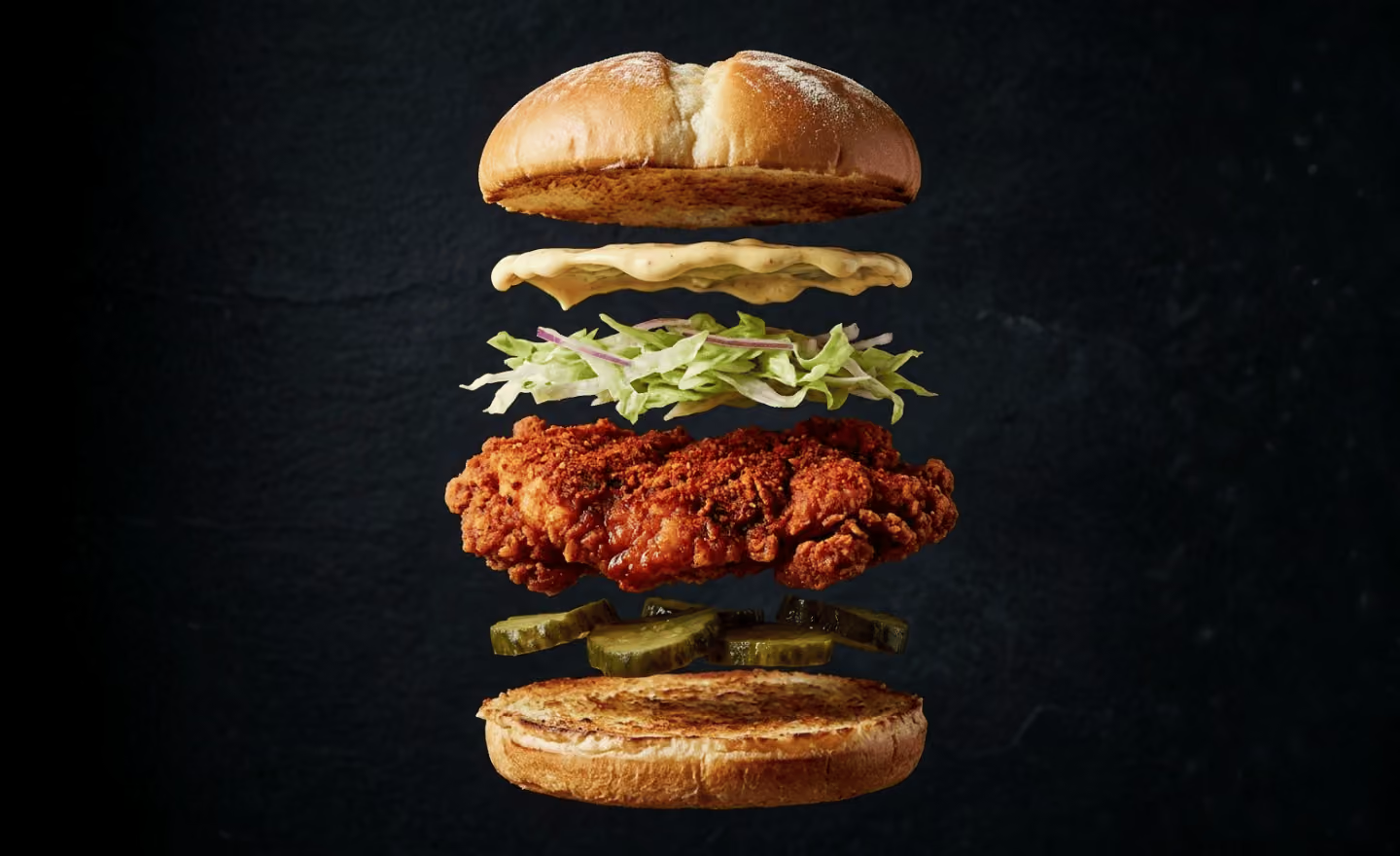
15. The Nashville Hot Chicken Sandwich - Nashville, Tennessee
What's on it: Fried chicken brushed with a cayenne and hot oil blend, on plain white bread, with dill pickle chips, usually held together with a toothpick.
What makes it different: The sauce goes on after frying, which is why the heat sits on the surface and hits immediately. The white bread isn't a garnish either. It soaks the spiced fat and gets eaten last, and it's the best part.
Where it came from: The Prince family, at what was then Prince's Hot Chicken Shack. The famous origin story, in which a scorned girlfriend doused Thornton Prince's chicken in cayenne as revenge and he liked it, is family lore with no documentation behind it. The woman has never been named in any telling. The family's date is the mid-1930s, while the documented business dates to 1945. Hot chicken and hot fish were part of Nashville's Black food culture before Prince's commercialized it, which suggests the shop is the popularizer rather than the inventor. The original Ewing Drive location was lost to a fire in 2018 and closed for good the next year; the family now operates several Prince's Hot Chicken locations around the city.
16. The Pimento Cheese Sandwich - Across the South
What's on it: Sharp cheddar, mayonnaise and diced pimentos, on soft white bread, crusts sometimes removed.
What makes it different: It's the most Southern thing on this list and it barely has to be made. Mix, spread, done. Which is exactly why it turns up at every church supper, tailgate and golf tournament in the region.
Where it came from: The North, as an industrial product. This is the best reversal in American food history and it's thoroughly documented. Food historian Robert F. Moss traces pimento cheese to New York cream cheese manufacturers, cheap canned Spanish pimentos that arrived in the late 1890s, and the Domestic Science movement's fondness for that red color. The first advertised pimento cheese ran in Austin, Minnesota in March 1910: "Pimiento Cheese-Something New." Georgia became the country's pimento-growing center in the 1920s through the 1940s, and cheap local peppers plus hoop cheese plus mayonnaise is how the South built its own version. When national interest faded after the war, Southern enthusiasm didn't. The Masters has served the sandwich since the 1940s, and still sells it for $1.50.
Vegetarian catering in New York City
17. The Carolina Pulled Pork Sandwich - North and South Carolina
What's on it: Chopped smoked pork on a plain bun with slaw on top. The details are where people stop being friendly.
What makes it different: Eastern North Carolina cooks the whole hog, chops it fine, and dresses it with vinegar, salt, and red and black pepper. Nothing else. Lexington and the Piedmont use shoulder, chop coarser, and add enough ketchup to the vinegar for body, which they call dip. Eastern slaw is white and mayonnaise-based; Lexington slaw is red, made with barbecue sauce and no mayo, chopped to about the size of BBs. South Carolina has a mustard belt of its own.
Where it came from: The commercial versions date to the early twentieth century, with Adam Scott in Goldsboro and Bob Melton in Rocky Mount on the eastern side, and Jess Swicegood and the Weaver-Ridenhour stand in Lexington from 1919. A nice causal detail: Lexington style was only possible once Heinz was mass-producing ketchup. Slaw on top rather than beside is old and well documented, showing up on a Georgia barbecue menu as early as 1880. One claim to avoid: the story that German immigrants gave South Carolina its mustard sauce is repeated everywhere as fact and has never been established.
The Midwest
18. Chicago Italian Beef - Chicago, Illinois
What's on it: Slow-roasted beef sliced paper thin, loaded into a crusty French roll with spicy giardiniera or roasted sweet peppers, then dunked in the roasting jus sauce.
What makes it different: The dunk, and the vocabulary around it. Dry, wet, dipped and double-dipped are all real orders, though the exact definitions shift from shop to shop. Ask for hot and you get giardiniera; ask for sweet and you get bell peppers.
Where it came from: Al's Beef opened in 1938 as Al's Bar-B-Q, and Al Ferreri usually gets the credit, but Al's own website credits his father Anthony from around the end of World War I. So 1938 is a business date, not an invention date. The story everyone tells, about Depression-era Italian weddings where thin slicing stretched cheap beef across a crowd, has no documentation at all, and no Chicago newspaper used the phrase "Italian beef" before the 1950s. Competing claims involve Pasquale Scala, the Ferraro family and an unnamed cook at a Greek coffee shop. WTTW's conclusion is probably the honest one: this sandwich came from a community, not a person.
19. The Jibarito - Chicago, Illinois
What's on it: Thin steak, garlic aioli, American cheese, lettuce and tomato, pressed between two flattened, twice-fried green plantains instead of bread.
What makes it different: There's no bread. The plantains function as bread, which makes the sandwich naturally gluten-free about forty years before that was a selling point, and gives it a savory, starchy snap that no roll delivers.
Where it came from: Juan "Pete" Figueroa created it at Borinquen Restaurant in Humboldt Park in 1996. This is one of the few well-documented origins here. The name is the diminutive of jíbaro, the Puerto Rican country dweller, a word that carries real affection on the island. Figueroa adapted rather than invented: an earlier plantain sandwich is credited to Jorge Muñoz at Plátano Loco in Aguada, Puerto Rico in 1991, itself descended from Venezuelan patacones, and most accounts say Figueroa got the idea from a newspaper recipe. The family moved the business north roughly two decades ago and now runs it as Borinquen Lounge on North Western Avenue in North Center, where the jibarito is still the reason to go.
20. The St. Paul Sandwich - St. Louis, Missouri
What's on it: An egg foo young patty, full of bean sprouts and minced onion, on plain white bread with mayonnaise, dill pickle, lettuce and tomato.
What makes it different: It's a Chinese-American takeout item that exists almost exclusively in St. Louis, and you cannot get one in St. Paul, Minnesota. It's also a legitimately great sandwich, which people tend to doubt until they eat one.
Where it came from: Not where the standard story says. Everyone credits a cook named Steven Yuen at Park Chop Suey in St. Louis in the 1940s, naming it for his Minnesota hometown. Researchers have found almost no trace of Yuen, and Park Chop Suey appears to have opened in the mid-1970s, which can't support a 1940s invention. What the archives do show is a "St. Paul sandwich" advertised in St. Paul, Minnesota in 1903 and 1904, as a ham-and-egg sandwich, plus St. Louis newspaper recipes for the same thing in 1916 and 1933, and an egg foo young sandwich in a Minneapolis column in 1937. The likeliest story is that an old American egg-sandwich name got borrowed, Chinese-American kitchens swapped in the patty, and St. Louis is simply where it stuck.
21. The Springfield Horseshoe - Springfield, Illinois
What's on it: Texas toast, meat, a mound of fries, and cheese sauce ladled over the whole thing. A half portion is a pony shoe, which is a neat piece of regional vocabulary.
What makes it different: It's open-faced, it's enormous, and the cheese sauce is a Welsh rarebit descendant rather than a nacho-style sauce.
Where it came from: Chef Joe Schweska at the Leland Hotel in the late 1920s, usually given as 1928, though the account rests on family recollection rather than records. His wife Elizabeth is credited with suggesting the rarebit sauce, which Schweska made with non-alcoholic beer because Prohibition was on. A man named Steve Tomko is sometimes credited instead, but he was a seventeen-year-old dishwasher at the Leland who learned to cook from Schweska and only claimed the invention after Schweska died. The original used bone-in ham cut in a horseshoe curve, with potato wedges arranged around the rim as the nails. The Texas toast and crinkle-cut fries came later.
22. The Breaded Pork Tenderloin - Indiana
What's on it: A pork cutlet pounded thin, breaded and deep-fried, on a plain hamburger bun with mustard, pickle and onion. The pork cutlet overhangs the bun by several inches, which is the entire aesthetic.
What makes it different: Ratio. There is roughly three times as much meat as bread, and no attempt is made to hide it.
Where it came from: Nick's Kitchen in Huntington, Indiana is widely credited. Nick Freienstein sold breaded pork cutlet sandwiches from a street cart starting in 1904 and opened the restaurant in 1908, so both dates you'll see are right about different things. Structurally it's a deep-fried descendant of Wiener schnitzel, and German settlement in the pork belt makes that plausible, though nobody has traced the actual chain. A pedantic note that Indiana will forgive: it's almost always cut from loin, not tenderloin.
23. The Reuben - Omaha, Nebraska
What's on it: Corned beef, sauerkraut, Swiss and Russian or Thousand Island dressing, griddled between slices of rye until the cheese gives.
What makes it different: It's assembled to be cooked, not cooked and assembled. The sauerkraut has to be squeezed dry or the bread fails, and the dressing caramelizes slightly against the griddle.
Where it came from: Contested, but the documents lean hard toward Omaha. The story there involves a grocer named Reuben Kulakofsky at a weekly poker game at the Blackstone Hotel in the mid-1920s, with the hotel's Schimmel family putting it on the menu. New York's claim centers on Arnold Reuben's delicatessen around 1914. Here's the thing: a 1934 Blackstone coffee shop menu lists "Reuben Sandwich … 40¢," which is the earliest known appearance of the name anywhere, and Andrew Smith, the leading advocate for the New York claim, later conceded that point. Arnold Reuben's documented creation was a different sandwich made with ham, turkey and coleslaw. What made the Reuben national was Fern Snider of Omaha winning the National Restaurant Association's sandwich contest with it in 1956.
The West Coast
24. The French Dip - Los Angeles, California
What's on it: Thin roast beef on a French roll, with jus. At Philippe's the counterman dips the roll for you, single or double.
What makes it different: The bread is engineered to be soaked, and the sandwich is one of the few where a soggy component is the goal rather than a failure.
Where it came from: Two Los Angeles restaurants founded in 1908 claimed it, and neither could document when the sandwich actually appeared. The best evidence is Philippe Mathieu's own account, given to the Los Angeles Times in 1951: a customer noticed gravy in the bottom of a roasting pan and asked him to dip one side of the roll in it. No dropped bread, no fireman with sore gums, and the meat was roast pork rather than beef, which undercuts most of the legends including the ones Philippe's tells today.
Philippe's is still going at 1001 North Alameda, though it retired its century-old sawdust floors in March 2026. Its rival Cole's did not make it: the Pacific Electric Building institution closed permanently on March 29, 2026, after 118 years, when a sale fell through. Whatever the truth of the origin, the argument now has only one side left standing.
Two notes for anyone writing about it. Au jus means "with juice," so "with au jus" is redundant. And the jus in most restaurants is a seasoned beef broth built on purpose, not literal pan drippings.
Sandwich catering in Los Angeles
25. The Bánh Mì - Vietnamese America
What's on it: A short, airy baguette with pâté and mayonnaise, pickled daikon and carrot, cucumber, cilantro and chilies, plus grilled pork, chả lụa, or a dozen other fillings.
What makes it different: The bread and the balance. A Vietnamese baguette is dramatically lighter than a French one, with a thin crackling crust and almost no chew, and the sandwich runs cold pickled acid against warm fatty meat in a way very few Western sandwiches attempt.
Where it came from: French colonization brought the baguette to Vietnam in the 1860s as an expensive import. The turn came during the First World War, when bakers cut wheat with rice flour to bring the cost down, and the loaf became street food. The modern filled version is often anchored to Hòa Mã in Saigon, which opened in 1958 as one of the first places selling bánh mì thịt. The lightness is partly the rice flour, but bakers say technique matters more: hard machine mixing, fast shaping, a long proof, and steam in the oven. The name is simply bánh (baked item) plus mì (wheat). In the United States, Orange County and San Jose have the deepest scenes, with Houston close behind and New Orleans East as the distinctive underdog. The jalapeño, incidentally, is an American substitution for Vietnamese chilies.
Asian fusion catering in the Bay Area
Honorable mentions
Twenty-five is not enough. Also worth your time: the Philadelphia roast pork Italian, with sharp provolone and greens, which plenty of locals rank above the cheesesteak. The Fluffernutter, which despite several attempts in the legislature is not the official sandwich of Massachusetts. The Bobbie, roast turkey with stuffing and cranberry sauce, born at the first Capriotti's in Wilmington and named for the founders' aunt. Iowa's loose meat sandwich and emphatically not a sloppy joe. The Santa Maria tri-tip sandwich, which is really Santa Maria barbecue on garlic bread. And Dutch crunch, the crackle-topped roll the Bay Area adopted so thoroughly that most people there don't know it's Dutch.
You'll notice burgers aren't here. That's deliberate, and they're getting their own post.
Nobody Set Out to Invent Any of This
The thing that stands out after going through all of these is how many were invented by accident or by nobody in particular. A hauler checking whether his potatoes had frozen. A customer pointing at the bottom of a roasting pan. A community of immigrant caterers stretching cheap beef across a wedding, with no single person to credit. The sandwiches we treat as regional monuments were mostly just somebody solving a small problem at lunchtime.
That's worth remembering the next time you're feeding a team. Good food is usually somebody local doing one thing extremely well, which is exactly what Sharebite is built to reach: thousands of neighborhood restaurants across the country, ordered through one platform, with a meal donated to a person in need for every meal your team orders.
Want to put a proper sandwich spread in front of your team? Book a demo today!