No Cafeteria? Not a lot of Budget? No Problem. Here's What Actually Gets People Back in the Building.
Quick Stats:
- 93% of leaders confirm more employees come in on days free lunch is offered
- 7 in 10 employees say they'd return to the office if lunch was provided
- From empty space to running food zone: under 1 week
The Moment Every Facilities Manager Knows
Imagine this: It's lunchtime on a Tuesday. Your office has 200 workstations. Forty of them are occupied.
Three employees just left for the coffee shop down the street. Two more are eating desk lunches alone, earbuds in.
An hour ago, your CEO asked why the office feels empty on Tuesdays. You manage the building. Now, somehow this occupancy problem became your problem to solve.
At Sharebite, we've helped set up food programs in hundreds of offices. Here's what separates the ones people actually use from the ones that collect dust.
Why a Lunch Program Is Also a Facilities Problem, Not Just an HR Problem
Think about why the coffee shop down the street keeps pulling your team out of the building. It's not just the coffee. It's that the coffee shop offers something your office probably doesn't: a designated place to land, linger, and connect without an agenda. A counter, a few stools, a predictable rhythm. People choose to be there.
Most mid-size offices have a pantry, not a gathering space. A pantry says "refuel and return to your desk." A lunch program with a proper pickup zone and a desiganted seating area says "stay a while." That difference is entirely physical, and entirely within a facilities manager's power to create.
Here's the reframe that matters: you don't need to build culture. You need to build the container for culture to happen. That's a spatial problem. Spatial problems are your domain.
Why the Obvious Solutions Don't Work
Before getting to the fix, it's worth uncovering what you've probably already tried and why it didn't stick.
The catering contract. Expensive. Inflexible. Minimum-spend requirements. One option for everyone. The person with a dietary restriction eats a sad side salad while the rest of the team works through a tray of pasta. Admin ends up stuck fielding complaints and coordinating drivers.
The upgraded pantry snacks. Great for 3 PM. Does nothing for the midday gathering problem. Employees still leave for lunch, and the pantry becomes a grab-and-go operation rather than a reason to stay.
The all-hands catered lunch. Great energy, and then forgotten. Ritual requires repetition. One-off events don't build it.
The pattern is consistent: most food solutions treat eating as a logistics problem. The ones that actually build culture treat it as a spatial and social design problem. That's a different kind of challenge, and it calls for a different kind of solution.
The Four Elements of a Real Office Food Zone
A functional food zone doesn't require square footage you don't have. It requires four things.
1. A defined pickup point. Organized, labeled, and findable. Not a pile of bags at the front desk. When employees can see exactly where their meal is and get to it without asking anyone, friction disappears. The pickup point also becomes the anchor that makes everything else work.
2. A lingering zone. Depending on your head count, two or three high-tops or counter stools placed near the pickup area do more for culture than any team-building exercise. When people have somewhere to stand and eat comfortably, they stay. When they stay, they talk. When they talk, things happen.
3. A rhythm. Same days, same delivery window, every week. Predictability is what converts a space into a ritual. One catered lunch is a nice surprise. Every Wednesday at 12:30 PM is a cultural anchor.
4. A system that handles the complexity. Dietary preferences, delivery coordination, individual labeling, order tracking. If the FM is managing this manually, it will collapse under the weight of the first employee who says "I didn't get my meal." The system has to run itself.
Sharebite Stations: The Cafeteria You Set Up in a Week
Here's what no facilities manager should have to hear twice: you don't need a construction crew, a capital approval, or a new vendor contract to solve this.
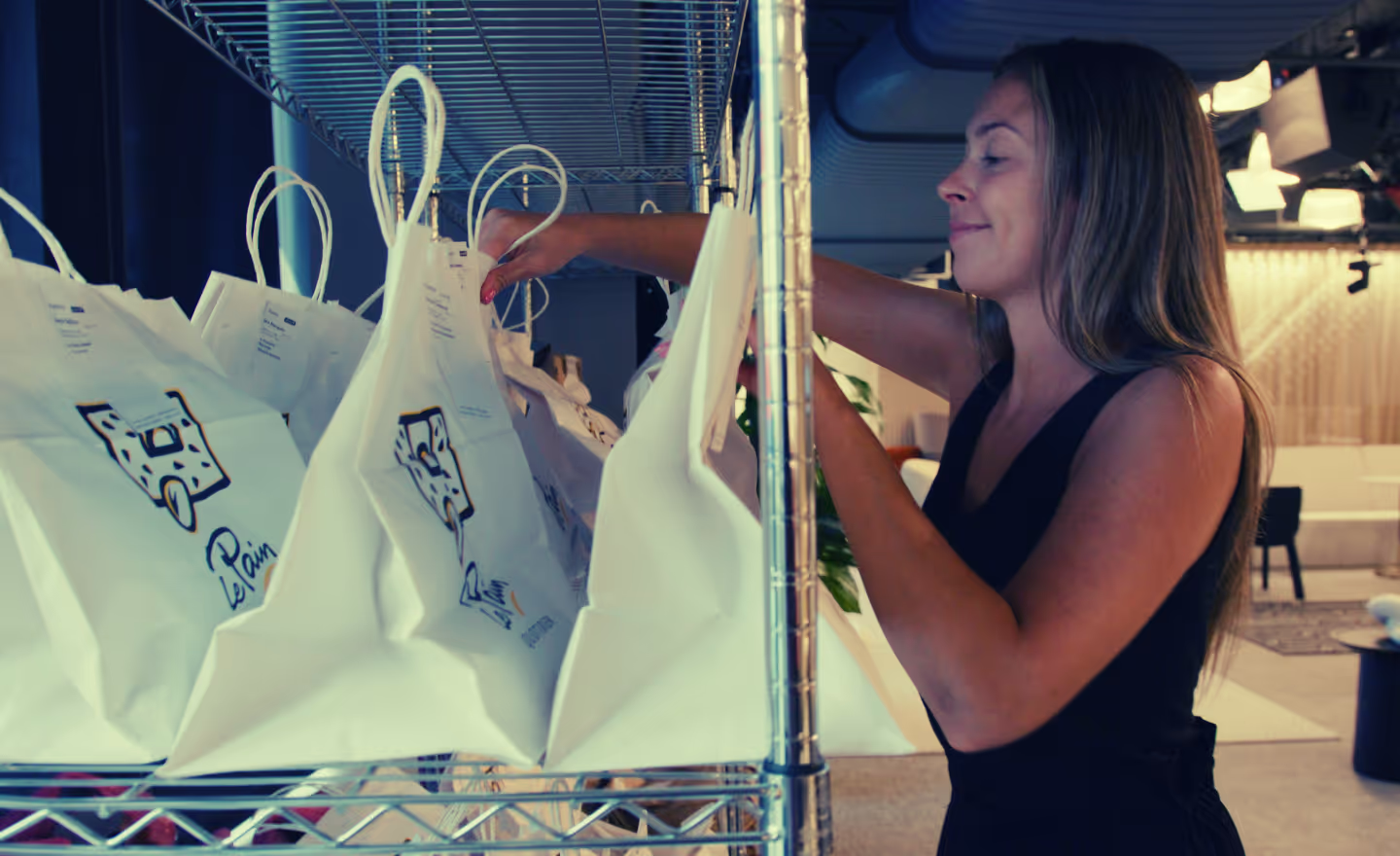
Sharebite Stations set up includes a physical shelving unit, provided and installed free of charge, that becomes the anchor of your office's daily group order.It turns any designated area into an organized, functional food pickup zone. No renovation. No build-out. No messy facilities project.
Here's how it works:
Invite. Each day, employees receive an invitation to the office group order featuring top restaurant options in your city. They browse and order from their desk or phone, with no delivery fees, no tips, and no minimum.
Order. Every employee orders individually from their preferred restaurant. Dietary preferences are captured during onboarding and applied automatically, so the person with a gluten intolerance isn't navigating that conversation every single day.
Deliver. Meals are made fresh, individually packaged, and labeled with each employee's name. They arrive in one batched delivery to your office, coordinated to the minute rather than to a 4-hour window. Sharebite's logistics team maintains a 98% on-time delivery rate, because group ordering only works if the food actually shows up.
Claim. Meals are organized on the Station shelving unit. Employees receive a notification when their order is ready. They walk over, grab their meal, and the lingering begins. No chaos. No cold food piled on the reception desk. No one asking the front desk team where their sandwich is.
What you get included with your Stations:
- A dedicated Account Manager who tailors the service to your office's specific setup
- 24/7 US-based Customer Care, so employee order issues go to Sharebite rather than to you
- An admin dashboard to control, place, track, and manage orders in one place
- Individually packaged and labeled meals, ready for easy consumption
What you don't manage:
- Vendor sourcing or restaurant relationships
- Individual order complaints
- Delivery driver coordination
- Dietary restriction tracking
- Per-order budget reconciliation
From empty space to a running Stations: under one week.
The FM Playbook: Five Steps to Your Food Zone
Making this happen is simpler than any other facilities project you've taken on this year.
Step 1: Find your anchor spot. Where do people already pause? Near the coffee machine? The elevator bank? The kitchen counter? You're not creating a new behavior. You're amplifying one that already exists. Start there.
Step 2: Map your dead space. What square footage sits underutilized on your peak in-office days? You need 30 to 100 square feet. That's a corner of a floor you're already heating, cooling, and maintaining.
Step 3: Zone it intentionally. Add some seating and tables nearby if you don’t already. Add signage. The physical signal matters. It tells employees "this is a place to eat and relax," not "this is where food gets dropped and picked up."
Step 4: Set the cadence. Start with two to three days per week. Wednesday and Thursday consistently see the highest hybrid in-office attendance. Consistency converts a space into a ritual. Once employees start planning their in-office days around what they will order for lunch, you know it's working.
Step 5: Let the system handle the rest. Sharebite manages the ordering window, restaurant rotation, dietary accommodations, delivery coordination, and employee notifications. You set it up once. It runs.
Signs it's working within 30 days:
- Employees lingering after pickup instead of heading straight back to their desks
- Cross-departmental conversations forming organically near the Stations
- In-office attendance on non-food days starting to creep up
- Your leadership team stops asking why Tuesdays feel empty
Your Next Step
Right now, companies across the country are converting underused office corners into food zones that bring their teams back to the building.
Your hybrid employees are choosing between your office and their couch on Tuesday mornings.
Your real estate costs the same whether 40 people show up or 200.
A Sharebite Stations doesn't just solve a lunch problem. It solves an attendance problem, an engagement problem, and a culture problem. All at once. In under a week or two.
Make It Effortless with Sharebite Stations
Sharebite powers group ordering for hundreds of companies, from 20-person startups to enterprise teams in Class A towers.
You get:
- Free Stations setup and installation
- Individual orders from top local restaurants, delivered as one batched arrival
- Individually packaged and labeled meals, organized on your Stations shelving
- Dietary preferences handled automatically, with no manual coordination required
- 24/7 US-based customer support so order issues never land on your desk
- An admin dashboard to control, track, and manage all ordering in one place
- A dedicated Account Manager who learns your office and keeps it running smoothly
- A meal donated to someone in need in your community for every order placed]
Your team gets connection. You get simplicity. The community gets a meal.
Ready to See It in Your Office?
Schedule a 30-Minute Walkthrough of Sharebite and we will answer any questions you may have!