When a meal benefit program underperforms, the instinct is usually to ask for more money.
More budget for better catering. A higher monthly stipend. An expanded restaurant selection. The assumption is that the problem is the benefit itself: that it's too small, too limited, too uninspired to actually move the needle on employee experience.
That instinct is almost always wrong. And acting on it without diagnosing the actual problem is one of the more reliable ways to spend significantly more money for marginally better outcomes.
The real driver of meal benefit failure in most organizations isn't budget. It's infrastructure. And understanding the difference is what separates companies whose programs genuinely improve employee experience from those that just have an expensive line item in the benefits budget.
Why More Money Doesn't Fix a Structural Problem
The most common meal benefit setup in corporate America today looks something like this: a company signs up for a group ordering account through Uber Eats, DoorDash, or Grubhub, loads employees with monthly credits, and calls it a benefit. For in-office days, they layer on a catering contract. It seems like it should work.
The problem is what happens at the edges. Catering contracts require committing to a headcount that hybrid schedules make nearly impossible to predict. Order for 60 people when 35 show up, and you've spent real budget on food nobody ate, while still failing to accommodate the employee who's dairy-free and just stared at a spread of cheesy pasta. Platform credits have their own ceiling: by the time delivery fees, service charges, and tips are factored in, a meaningful portion of the benefit's dollar value never reaches the meal itself. And none of it helps the employee working from home.
More budget applied to either model produces a more expensive version of the same structural problem. The organizations that have genuinely fixed their meal benefit programs didn't start by raising the stipend. They started by asking a harder question: why isn't the current benefit actually working for every employee?
The Friction Problem Is Hiding in Plain Sight
Low utilization is almost always a friction problem. When a meal benefit is locked to a specific delivery platform, requires navigating a limited merchant catalog, or forces employees through a reimbursement process to access what should be a straightforward perk, a predictable percentage of them simply won't bother. That percentage skews toward exactly the employees the benefit was supposed to reach: remote workers without a convenient vendor nearby, hybrid employees whose schedules don't align with fixed delivery windows, and employees in smaller offices who fall outside the primary catering contract.
The Case for Removing the Constraint Entirely
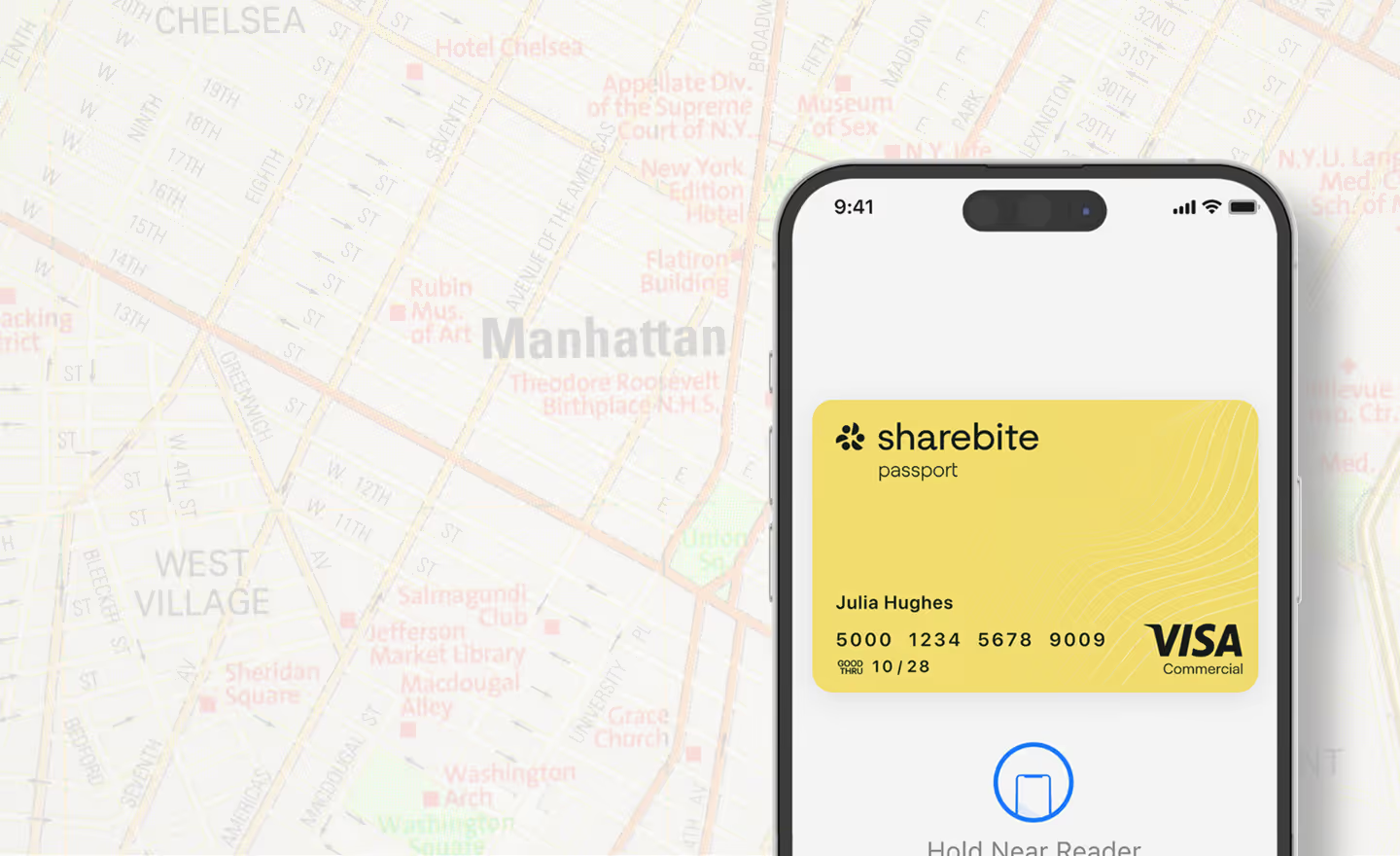
The solution isn't a better catalog or a higher credit limit. It's removing the constraint entirely. Sharebite Passport issues each employee a virtual card that works at any restaurant merchant that accepts credit cards. The employee who wants to order DoorDash can pay with their Passport card. So can the employee who'd rather walk to a food truck, eat at a sit-down restaurant, or grab a quick bite near their home office. The card adds directly to Apple Wallet or Google Wallet, so there's no new ecosystem to learn. Employers who require a location check-in have the option to use the Passport mobile app, but the app is a policy tool, not a barrier between the employee and their benefit.
When the path of least resistance is simply using the benefit, utilization follows.
The Equity Blind Spot That's Costing You Retention
There is a version of meal benefit inequity that's invisible on a spreadsheet but entirely visible to employees: the divide between who gets a catered lunch on a Tuesday and who doesn't. In a hybrid organization, that line often corresponds almost perfectly to the split between in-office and remote workers. Companies that don't address this explicitly, with a benefit structure that works regardless of where an employee is, are making a statement whether they intend to or not.
The business cost shows up in retention data before it shows up anywhere else. Remote and hybrid employees who feel like second-class citizens in the benefits program leave. They don't usually say so directly. They say they found a better opportunity, and that better opportunity often includes a company that thought more carefully about what an equitable benefits experience actually looks like.
A Benefit That Travels With the Employee
Sharebite Passport travels with the employee. Whether someone is working from their home office in Austin, a co-working space in Chicago, or visiting a client in New York, the benefit works the same way. Every employee has the same access to the same benefit, which is what equity actually means in practice.
What Finance Leaders Should Actually Be Measuring
The ROI conversation around meal benefits is usually framed around cost per employee. That's the wrong frame. The right questions are: What is the actual utilization rate, and how does it vary across employee segments? What is the true administrative cost of running the program, including staff time and not just vendor fees? And can you demonstrate any correlation between meal benefit access and engagement or retention outcomes?
Programs built on a unified platform are the ones that can finally answer these questions. Consolidated spend dashboards, configurable budget controls, and per-employee utilization data aren't luxuries. They're the baseline for treating meal benefits as a managed investment rather than a recurring guess. Increasing the budget on a program that can't answer these questions isn't a benefits strategy. It's a guess with a bigger number attached to it.
The Infrastructure Question Worth Asking
The companies getting this right aren't necessarily spending more. They're spending more deliberately. They've replaced the patchwork of vendors, reimbursements, and location-dependent programs with infrastructure built for how their workforce actually operates today: distributed, flexible, and not reliably in the same place on the same days.
Sharebite Passport is one of the clearest examples of what that infrastructure looks like in practice. It doesn't require employees to change how they eat. It requires companies to change how they think about delivering the benefit.
The right question isn't "how much should we spend on meal benefits?" It's "are we spending it in a way that actually reaches every employee, every day?" For most organizations right now, the honest answer is no, and no amount of additional budget will change that without getting the infrastructure right first.