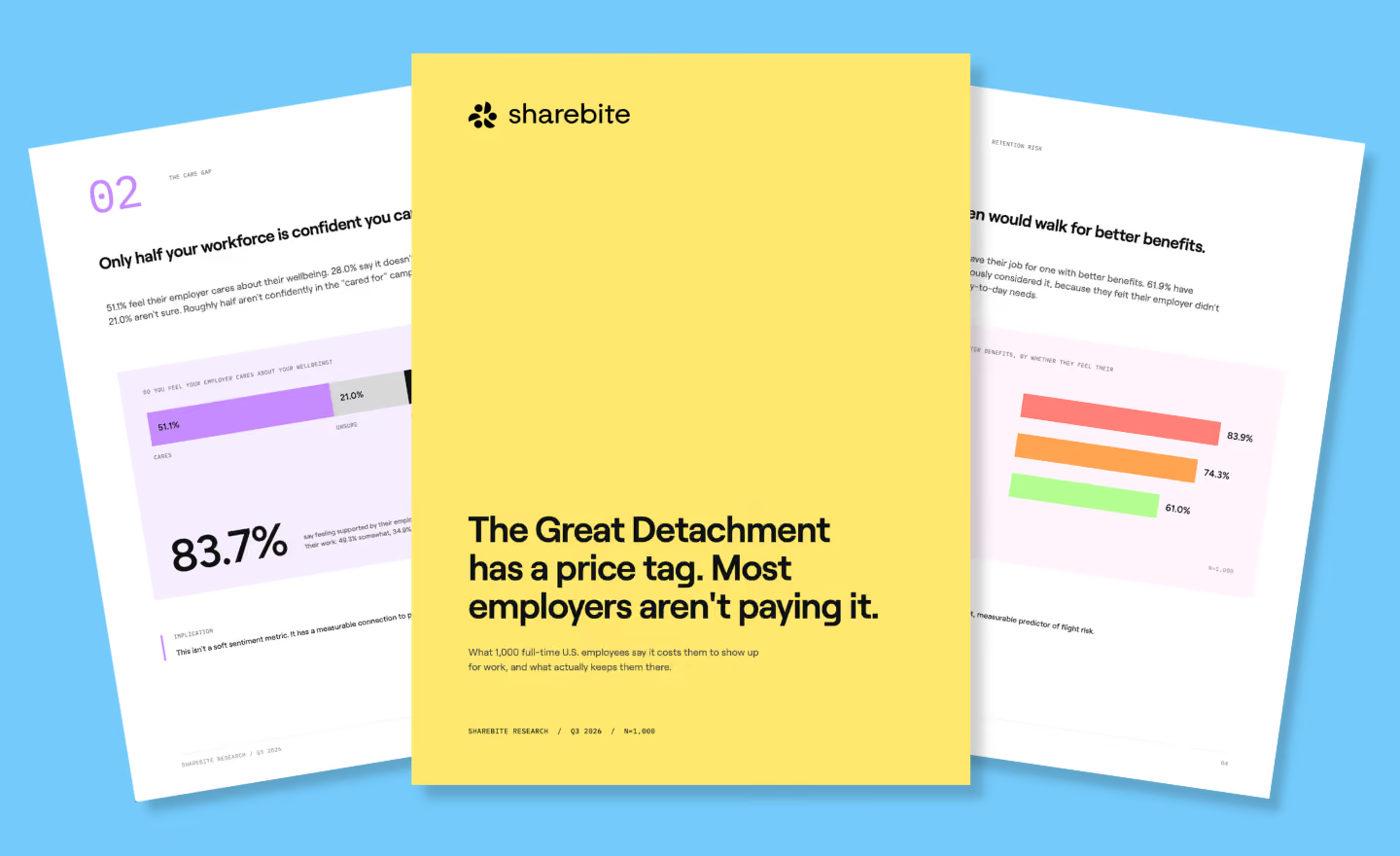
New Sharebite research, fielded across 1,000 full-time U.S. employees in Q3 2026.
2026 has been the year of the return-to-office mandate finally sticking. Attendance stopped being a suggestion. Exceptions got harder to get. The debate that dominated the last four years quietly resolved itself in management's favor, and most employees went back.
What management got in return was not what it was hoping for.
Employees came back to their desks and stayed in their jobs, but a lot of them stopped bringing much of themselves to either. Economists have started calling it the Great Detachment: workers who aren't quitting, aren't complaining, and aren't especially engaged. Turnover looks fine on the dashboard. Everything downstream of turnover does not.
Layer onto that a cost of living that never came back down. Rent, groceries, gas, childcare. The math of showing up to an office five days a week is meaningfully different in 2026 than it was in 2019, and for a lot of people it now runs into real money. That cost lands on the employee. Almost nobody is pricing it into their retention strategy.
We wanted to know what that actually looks like from the employee's side, so we asked. In August 2026 we surveyed 1,000 full-time U.S. employees about benefits, wellbeing, office attendance, and what makes them stay or start looking. The full report runs nine sections. Three of them changed how we think about the problem, and we're publishing those here in full.
1. The care gap is a retention gap, and it's measurable
Start with the number that frames everything else: 69.1% of employees say they would leave their current job for one with better benefits.
Seven in ten is high enough that it's tempting to dismiss. Of course people would take better benefits. Who wouldn't?
But the number moves, sharply, depending on one thing. We asked employees whether they feel their employer cares about their wellbeing, then looked at how each group answered the question about leaving.
Among employees who feel their employer doesn't care, 83.9% would leave for better benefits. Among employees who aren't sure, 74.3% would. Among employees who feel their employer does care, it drops to 61.0%.
That's a 23-point spread driven by perception alone. Same labor market, same benefits, different read on whether anyone at the top is paying attention.
Now the uncomfortable part. Only 51.1% of employees say their employer cares about their wellbeing. 28.0% say it doesn't. 21.0% aren't sure. Roughly half your workforce is not confidently in the "cared for" camp, and that half is measurably more likely to be looking.
We also asked whether this has already cost anyone a job. 61.9% of employees have left a job, or seriously considered leaving one, because they felt their employer didn't care about their day-to-day needs. Not compensation. Not title. Day-to-day needs.
And in case anyone wants to file this under soft metrics: 83.7% say feeling supported by their employer affects their work, with 34.9% saying it affects it highly. Whatever "feeling cared for" is, it isn't decorative.
The practical read here is that the "unsure" group is the opportunity. Employees who have concluded their employer doesn't care are expensive to win back. Employees who genuinely don't know are one visible, consistent signal away from moving into the other column.
2. People are skipping meals to keep up, and it predicts who leaves
This is the finding we did not expect.
71.7% of employees skip, delay, or cut short at least one meal every week because of work. More than a quarter, 28.3%, do it three or more times a week. And 47.6% say it affects their ability to perform.
A meal skipped because a meeting ran long is an unremarkable thing. It happens everywhere. What made us look twice was what happened when we cross-referenced meal-skipping against the retention question.
Among employees who have left or seriously considered leaving a job over feeling uncared for, 33.5% skip three or more meals a week. Among employees who haven't considered leaving, that figure is 19.7%.
Run it the other way and the gap holds. Only 21.7% of the leave-considerers skip zero meals in a typical week. Among the employees who've stayed content, 40.8% skip none.
We want to be careful about what this does and doesn't show. This is a descriptive cross-tab, not a causal claim, and we say so plainly in the methodology. Skipping lunch does not make someone quit.
But it does look like a symptom worth watching. The employees who are eating badly because of work are the same employees who have already thought about leaving. If you run a People function and you're hunting for early signals that don't require another engagement survey, this is an unusually cheap one. You can see it in the office. You can see it in whether the food you provide gets used.
3. Food is the only return-to-office lever that reliably works
Most RTO strategies in 2026 are built on mandates. We wanted to know what would work without one, so we asked employees a straightforward question: assuming no required in-office days, what would actually motivate you to come in?
Free meals, snacks, and beverages: 38.9%. More than double the next answer.
Here's the full ranking:
Two things stand out. First, food beats the office renovation by 20 points and beats the commute subsidy by 25. That ordering should give pause to anyone with a workplace capex line item bigger than their food budget.
Second, look at the 19.0%. Roughly one in five employees says nothing would bring them in voluntarily, which is a useful reality check on how much any perk can accomplish. But it also sharpens the point: among the 81% who are actually reachable, food is far and away the most effective thing you can offer, and it's the one that takes weeks to implement rather than quarters.
What this adds up to
Read those three findings together and a pattern shows up that we didn't set out to find.
Companies are currently spending enormous amounts of money and political capital on two theories of the productivity problem. The first is that people need to be in the office. The second is that AI will make up the difference. Our data has something to say about both, and the second one is a whole section of the report on its own.
What the data keeps pointing at instead is something smaller and more boring. Employees are stretched. They're absorbing costs their employer isn't seeing. They're making small daily compromises, like eating badly, that they read as evidence of how much their employer values them. And they're translating that read directly into whether they stay.
That's a support problem. Support problems are cheaper to fix than culture problems, and much cheaper than replacing seven in ten of your team.
What's in the full report
The three findings above are a third of it. The other six sections cover:
- Who actually needs cost relief, including the company-size finding that surprised us most (the acute need isn't where you'd guess)
- How meal and snack offerings shape what employees believe about your company's financial health and culture, and which of those two they weight more heavily
- Where workplace relationships actually get built, ranked
- The full ranking of what employees say is dragging their performance, and where benefits land against salary and workload
- The AI section: how much AI has actually changed the workday, who's feeling it, and the one category of decision employees overwhelmingly refuse to trust it with
- Full methodology and cross-tabs
It's 15 pages, it's free, and it's built to be forwarded to a Chief People Officer.
Get the full report
The Great Detachment has a price tag. Nine findings from 1,000 full-time U.S. employees on benefits, burnout, office attendance, and what actually keeps people in their seats.